More Than Good Workers: The Human Case for Immigrant Farm Labor
This week we welcomed back to Featherstone Farm, 5 of our most senior farmworkers from Mexico. Jose, Emilio, Antonio, and Victor, along with Gerardo and Mote (not pictured). This is one of the best weeks every year on the farm; like robins, they are harbingers of spring. More importantly, they are great employees and even better human beings.
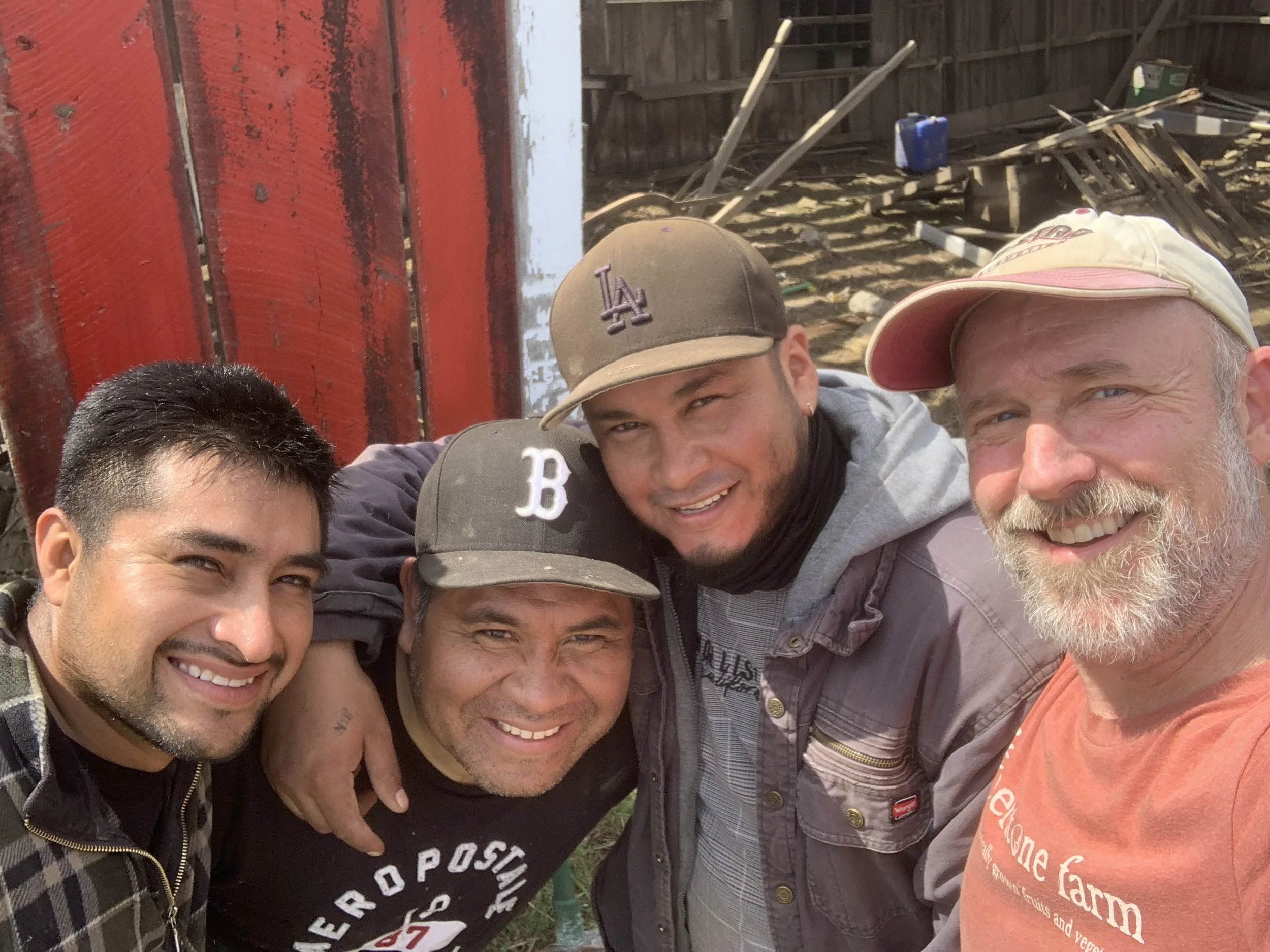
Jack with some of Featherstone Farm’s most senior H2-A seasonal farm workers.
Each of these guys have between 12 and 15 years invested in working at Featherstone Farm; they come every spring with H-2A visas, issued by the U.S. Department of Homeland Security. Jose’s father and grandfather worked at Featherstone Farm years ago. All 5 of these guys have introduced us to cousins, in-laws and others, who now work at FF as well.
Why We Need Immigrant Labor at Featherstone Farm
I think it’s safe to say that Featherstone Farm would simply not exist without these guys and their extended family members coming to work. Each year, as part of the process of applying for visas, we are required to post their jobs in the media, on statewide job boards, and everything in between.
Last year’s posting offered $18.54/hr plus housing and transportation to and from the farm. In the 20+ years we have been making such posts, I could count on one hand the number of “local” job applications we’ve received. The saying gets old and worn, but it’s true: Americans simply will not do these jobs.
Why? Well, for one thing, there is very little schedule. There are always 48 hours/week of work, often with overtime (paid at time-and-a-half). But the schedule is almost completely determined by weather, and the ripening of crops that it drives. Big storm predicted midmorning? Let’s start at 5:00 am, not 6:00, to get that broccoli planted. A week of 94 degrees during melon season? Let’s work until 7:30 or 8:00 every night, to get those melons out of the field before they spoil. Saturday and Sunday night, too.
To be viable in an age of destabilized climate, a farm like Featherstone needs lots of fieldworkers essentially “on call 14/7” for 5+ months of the year. We’ve tried to get away from this kind of variability—to impose some sort of more formal schedule—but we simply can’t. Things are different in arid California, where the weather is very, very similar every single day between May and October. But not here in the Midwest!
More Than Just “Good Workers”
Featherstone Farm’s Spanish speaking employees have been welcomed into the rural Fillmore County community with open arms for 2+ decades, by and large. There have been many remarkable stories of “rural neighboring” for immigrants over the years, and very few (if any!) clashes (that I’m aware of, anyway). All of us are super grateful to the Rushford area community for this!
I sometimes get the feeling that these fieldworkers are seen primarily as “good workers” from the windows of vehicles passing along the 2 state highways that abut most of our fields. Rural people honor and respect the dignity of work, as I do. And they recognize what I described above: that “Americans just won’t do this work”. “You’re lucky to have such good workers” I hear very often. Great, I certainly am!
And yet, I sometimes wonder if this understanding does not miss the forest for the trees. These are not just productive robots out there planting, tending and harvesting vegetables. If they were, Featherstone Farm might be just as productive, but far less vital.
Because the people that come from Mexico to work with us every year are human beings that are here to provide for their families back home. They bring their language, culture, food and so much more with them, and they re-energize our community in the process.
I will never forget an experience I had two days after the devastating flood of 2007, when I was sitting in the farm’s ramshackle office, worrying that we were done for, that the farm would close in days not weeks. Floating into the office window came an infectious laughter; it was Olegario (Jose’s father) outside packing melons, joking around with his brothers about… it doesn’t matter.
These guys were laughing heartily in the face of disaster. It was like a beam of sunshine through the very darkest clouds in the 30 year history of Featherstone Farm. That laughter represented not just a joie de vivre, but a kind of personal resilience that we can all aspire to. I’m not sure any person not acquainted firsthand with profound loss and hardship (i.e., many Americans) would have had that kind of resilience in them. I know I didn’t—at that moment, anyway. I will never forget that laughter.
SO… how to repay the human element here, as well as compensate the worker with a paycheck? Well, Featherstone Farm and its employees have done MANY things over the years… I’m not going to begin to list them. But suffice it to say, the farm’s “fair labor” certification (by the Fair Food Program) is testament that we go well above and beyond the baseline requirements for housing, transparent contracting, and fair labor practice, required by the Department of Homeland Security. We always have.
I believe that employing these families from central Mexico has been a huge win-win for decades. The farm exists and feeds thousands—perhaps hundreds of thousands—of people every year. The employees generate wealth which translates directly into better homes and livelihoods back home; we have seen the improvements over the years, big time.
I am very proud of this arrangement as a farmer-employer. I am also delighted with it, from a human perspective. Welcome back Gerardo and Mote, Jose and Antonio and Victor! We look forward to another wonderful season with you in our lives!
Gratefully,
—Jack